Lumpen: A Journal of Poor and Working Class Writers is again open for submissions, and the theme of the upcoming issue is Work.
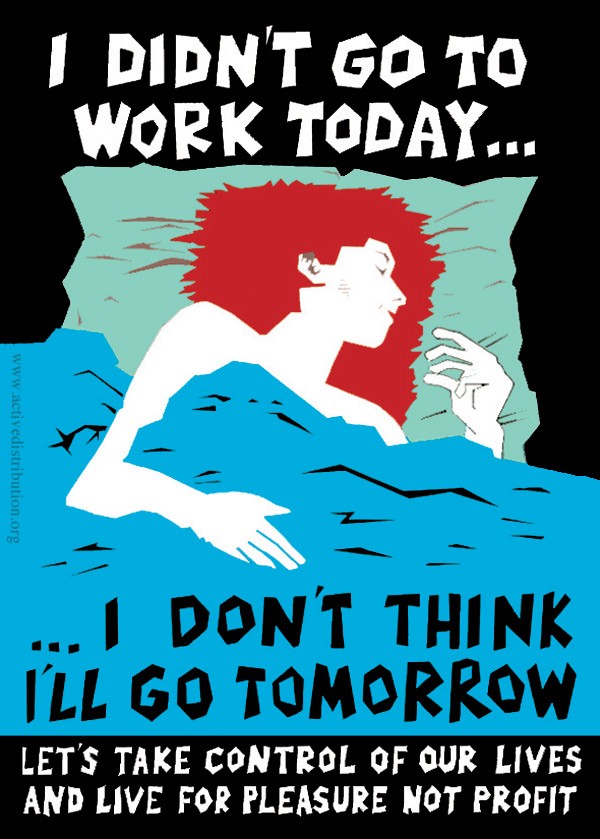
When I was younger, almost every radical left space I was hanging out at had this poster stuck up the wall, the one showing a person cosied up in bed and proclaiming: “I didn’t go to work today, I don’t think I’ll go tomorrow.” At the bottom, it said: ‘Let’s take control of our lives and live for pleasure not profit.’
Now, I have no issues with people refusing to work, for whatever reason really, however there was always something that really bothered me in this poster and its popularity, and it was the level of inexplicit privilege it displayed. The thing is, back then I was hanging out mainly with the squatters, the anarchists, the ravers and the lot, and there were, to simplify it, two main groups of such: the people who could easily choose to disengage from any kind of labour with little consequence, and those who, should they not comply with the capitalist requirement to engage in work, would see their lives spiralling out of control pretty fast and pretty bad, and on many levels. Some of course chose this route, but in my books they didn’t so much choose to not work as much as they chose to disengage from the mainstream capitalist forms of labour, instead “making their living” by all sorts of other, more “underground”, less “respected” and more “antisocial” forms: work it was regardless and I commend (almost) all of them. There was also the group who had no such choice at all and they were simply denied work opportunities by the society we live in: this predicament was a horrible, life-changing type of struggle for them.
Not too many had the choice as presented in the poster in question, that is, to roll from one side of the bed to the other carelessly while making dismissive statements about something that is a basic experience of the vast majority of humans. And of course, while the years passed, we all realised that those who could afford this privilege, usually enjoyed a whole spectrum of other privileges, be it the comfort of sleeping in while knowing that the Bank of Mum and Dad would always bail them out, or the comfort of knowing that no matter how much they mess up, there is always going to be some money waiting for them in the trust fund. Or that, if and when they do decide to work, their first job will elevate them several social ladder steps right to the top of it, over the heads of the regular folk, and that this privilege was given to them at birth and that they always knew it was there whenever they chose to take it.
Back then, like many less privileged peers, I worked in all sorts of roles that I either considered enjoyable and worthwhile or not: most of them was outdoor labour. Whatever I thought of them, there was never a question that I would be able to voluntarily and without far-fetching consequences opt out of work, and this silly popular poster was rather symbolic of the general detachment of what is called the leisure class. After all, for the regular mortals in our society, the saying “two paycheques away from eviction” is not a slogan, it is a pretty scary reality.
There are, of course, other forms of work besides the paid type that are required to make our societies keep rolling, such as emotional or reproductive labour. These are often undertaken on top of paid work, and, more often than not, they are assigned to class, gender or racially oppressed people. These need to be recognised too, and they too leave little room or choice for, to quote that poster again, taking “control of our lives and live for pleasure not profit” - although life based on pleasure over anything else does sound like a nice if unachievable idea.
For the next issue of Lumpen, we would like to hear from you about your experiences of work, paid or unpaid, respected or dismissed by our society, legal or illegal. Tell us what work means in your life, why do you engage in it, or why not. How do you survive in a society that requires us to make money to live, and how do you handle that while also handling your life and unpaid work?
We especially encourage submissions from those often excluded from class discourse in the UK. These groups include:
Additionally, we want to assure you that if you have never been published before, this will work to your advantage! As always, we welcome all levels of writing and language skills: if we think improvements are needed, we will work with you in a friendly, non-judgemental manner.
Some house rules:
• Word count: 800 minimum, 2,400 maximum (with some flexibility either way).
• Deadline: 21st February 2026
• The authors of published texts will be offered a small fee (£50).
• We no longer accept poetry.
All submissions and questions should be sent to editor@theclassworkproject.com
If you are not sure about your submission idea and would like to discuss it before sending it in: do get in touch! We will discuss it with you and do what we can to assist you to develop it and make it as great as it can be. Our editor is here to help you, so don’t hesitate!
Zosia Brom.